
De captivants à banals, les articles et photographies de “The Baguette” sont une tentative de publier un journal de ma vie dans la Manche et de proposer un forum de discussion pour tout ce qui touche à la Normandie.
The Église paroissiale Notre-Dame in Montbazon was built between 1851 and 1862 under the direction of Gustave Guérin.  Two artists named Jules Benard and Alexandre Ripault painted all of the décor including the spacious barrel-vaulted nave and its walls in 1863 in the Romanesque style.
  Henri Grandin was the master painter and painted all of the faces to the figures that Benard and Ripault created.
 The décor is done in stencil rather than fresco with scenes and depictions of saints in feigned / trompe-l'œil niches. Grandin also painted the religious statues and Stations of the Cross.
  This sort of design reflects the popularity of the second half of the 19th century for painted decoration. As of 2003 all paintings have been restored and look fantastic! It was something I did not expect to see in an unassuming small-town church. I was fascinated by the amount of detail in nearly every square inch.
 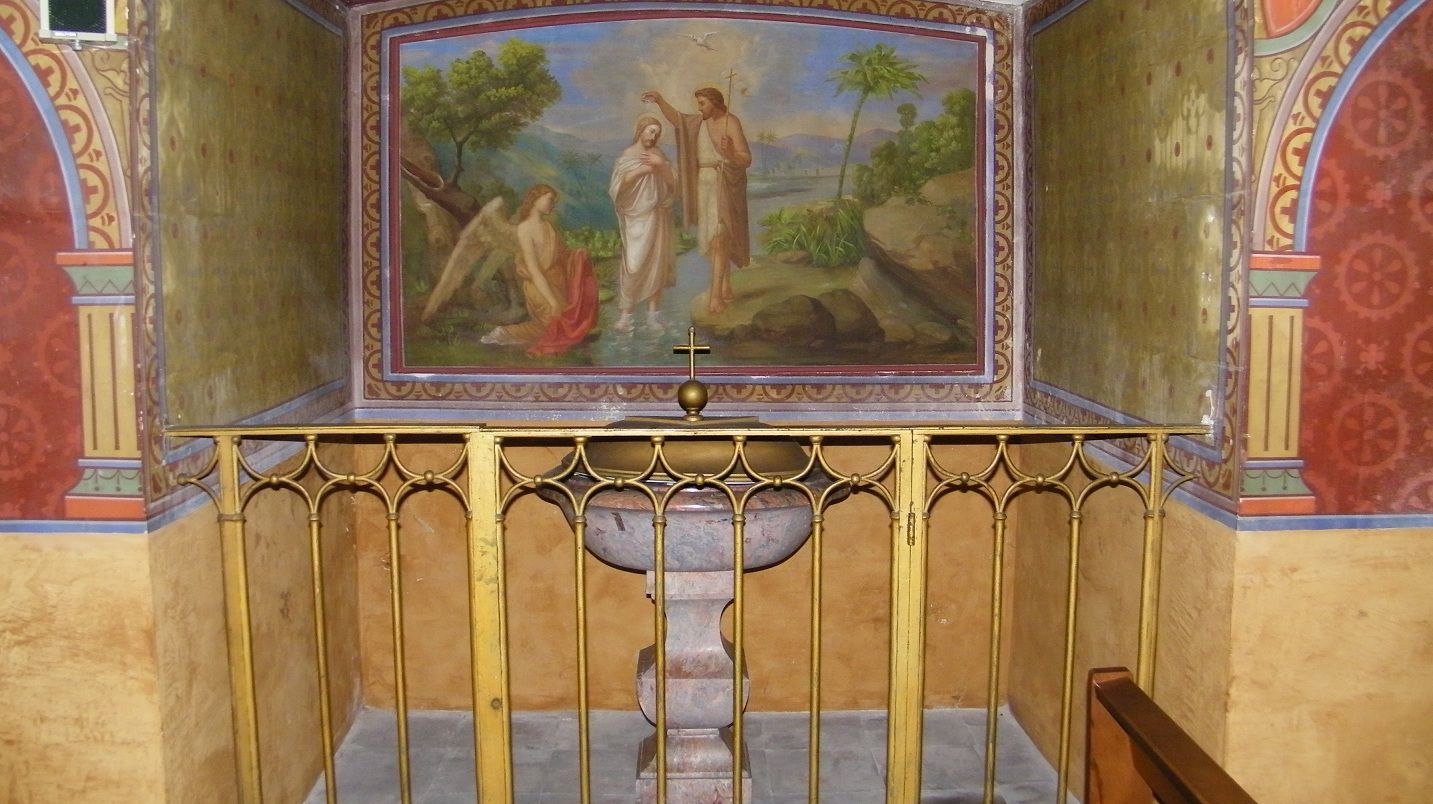 Fulfilling the wishes of Montbazon’s curé, Abbé Chauvin (1848 – 1890), the principal illustrations for the church are based on feasts held during the liturgical year, Church dogma and popular devotions of the parish. These included the Mysteries of the Trinity, the feasts of the Virgin, Sacred Heart, Christmas, Easter, Ascension, Pentecost and Corpus Christi.
  The windows above the altar depict the important events in the life of Mary: the Annunciation, the Nativity, Christ’s Crucifixion, the Assumption and, at the top, the crowning of Mary Queen of Heaven. The window on the left is Mary with the Infant Child and the window on the right is John the Baptist. They come from a painted glass factory in Tours and were created by Julien Léopold Lobin in 1848.


/idata%2F3191025%2FChateaux%2F2226-Le-Logis-Renaissance-et-la-forteresse-medievale--Mon.JPG)
/idata%2F3191025%2FChateaux%2F2100-Logis-royal-et-Jardin-publique--Loches.JPG)
/idata%2F3191025%2FChateaux%2F1699-Jardin-d-inspiration-medievale--Chateau-de-Langeais.JPG)
/idata%2F3191025%2FLe-Lude%2F1529-Chateau-de-Villandry.JPG)