
De captivants à banals, les articles et photographies de “The Baguette” sont une tentative de publier un journal de ma vie dans la Manche et de proposer un forum de discussion pour tout ce qui touche à la Normandie.
 The small town of Saint-Pierre-d’Arthéglise was ascribed from the juxtaposition of two names—Saint Pierre, the name of the patron saint of the local church and another name, Arnketill, from Anglo-Scandinavian origin meaning “church of Arnketill”. One finds in old texts from 1150 the name: Sancti-Petri Archetiglise as well as a name from a 1760 text: St-Pierre-d’Arthéglise-en-Rivière (meaning by the waterfront). The heath of Bosc-de-la-Haye, which used to be more extensive than it is today, belonged to the lords of Breuil and the lords of Sortosville-en-Beaumont. For each animal that was put there to graze, the local inhabitants had to give one chicken and ten eggs on the feast day of Saint John the Baptist. The two lords shared the royalties from the land. In 1819, the heath covered an area of 270 hectares or about 46 percent of the territory of the commune of Saint-Pierre-d’Arthéglise. They were the only ones who levied such a tax on each animal that was put there to graze as it was their sole source of income: 0.23F for cattle and 1.30F for horses in 1817. Each animal was then branded with the mark of the town.
  In 1834, the town council decided to sell or rent out portions of land to meet the cost of building a church tower and to create income for the church and its rectory. With the exception of the base of the bell tower, the church underwent a complete renovation in the 19th century (1835 – 1840) leaving no trace of the medieval sanctuary.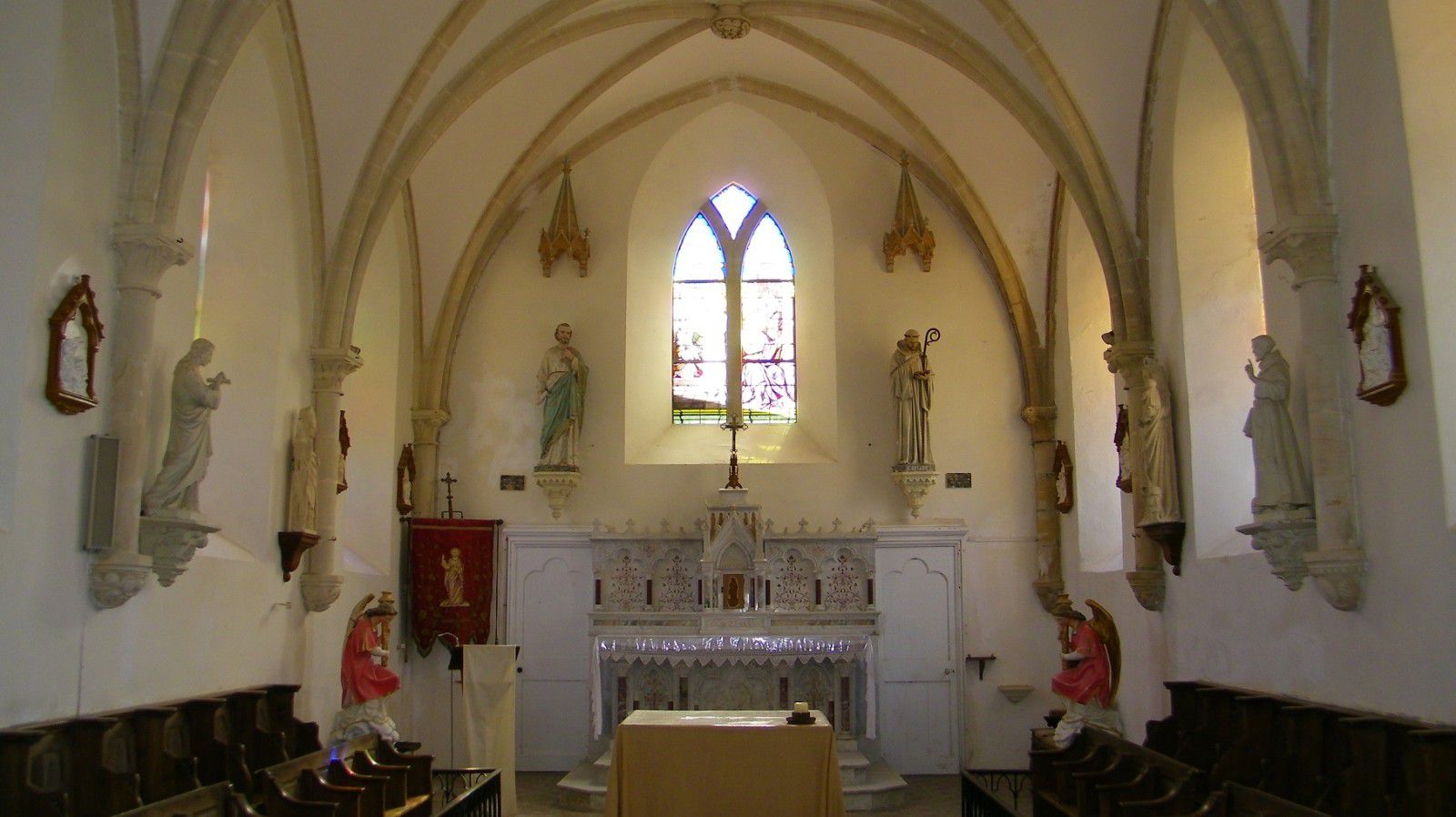
 Still there are some interesting pieces that have been preserved and are on display within the church: the Education of the Virgin, the Flagellation and a rare statue depicting the Trinity. In the cemetery, near the door, along the south wall of the chancel, is a grave stone from Yvetot-Bocage with the following inscription: “HERE LIES THE BODY OF LELAIDIER, CURÉ OF THIS PARISH, CONFESSOR OF THE FAITH, ZEALOUS PASTOR, FATHER TO THE POOR, DIED 9 JANUARY 1841, AGE 81 YEARS, PRAY FOR HIM.” Abbe Jean-Jacques Lelaidier, born in Tréauville, was the vicar of Baudeville in 1791. As its pastor, he refused to swear allegiance to the civil constitution of the clergy and in September of 1792, sailed for Alderney and exiled himself in England. He returned to France after the Concordat of 1801 and died as the parish priest of Saint-Pierre d’Arthéglise.
 The south chapel is dedicated to Sainte-Anne and the Education of the Virgin. Above the altar is a work in stone from the 15th century. The donor, holding a shield, is shown in the lower right.
  Opposite the altar is a painted traditional Pietà.
  Take a look at the fine, small polychrome wood sculptures surrounding the tabernacle.
  The Flagellation from the 14th century, located on the north wall, is made from English alabaster and probably comes from the workshops of Nottingham. Christ is represented from the front with His hands tied to a thin column while four bearded executioners raise their scourges. This piece was probably part of an ensemble that illustrated the Passion.
  A statue of the Trinity, located on the south wall of the nave, is not unlike the one visible in the church of Golleville. The Father, wearing a three-tiered tiara, sits enthroned bearing the cross of Christ with His hands. The wings and the tail of the dove touch the Father’s beard while the beak touches Christ’s crown of thorns.
  The north chapel, under the bell tower, was dedicated to Saint-Ortaire, secondary patron of the parish, who lived in the 6th century. Tradition says that he was raised in Dézert and became the abbot of Landelles-et-Coupigny, a canton of Saint-Sever in Calvados where he died. The feast of Saint-Ortaire is still celebrated in this town at the end of May. He is invoked for the healing of children, the disabled and rheumatism. Traditionally, he is represented dressed in a hooded robe, carrying a book and leaning on a pastoral staff. In the Saint- Ortaire chapel, to the left of the splay of the window, is the following inscription written in Gothic letters.
  Deciphered, it reads: “HERE LIES THE REMAINS OF AN HONEST MAN, BLAISE FLAMBART WHO LIVED IN SAINT-PIERRE D’ARTHEGLISE AND FOUNDED THE PERPETUAL MASS TO BE SAID IN THIS CHURCH ON THE NIGHT OF THE HOLY RESSURECTION WITH HYMNS FOR OTHERS WHO HAVE DIED AND THAT A MASS MAY BE SUNG AT HIS GRAVE DURING VESPERS FOR THE PRICE OF SIX SOLS AND FOR THE BENEFIT OF OTHERS ON THE DAY OF RESSURECTION. THE ANNUITY HAS NO END FOR THE DECEASED. HE DIED THURSDAY, 7 MAY 1620. MAY GOD FORGIVE THE SINS OF THOSE WHO HAVE DONATED. AVE MARIA.”
 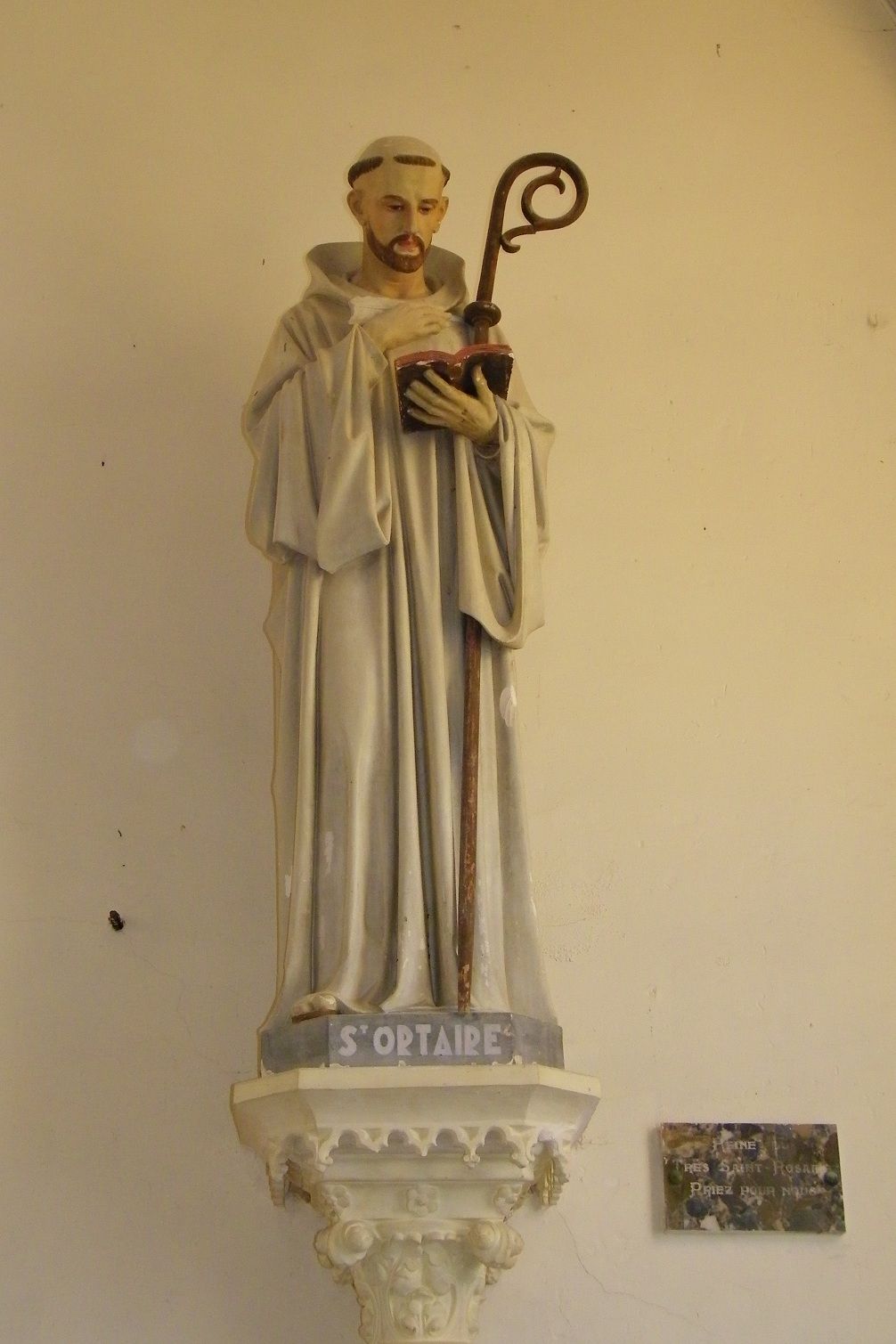 In this church, Saint-Ortaire’s statue is to the right of the high altar. Another statue in wood is on the side of the tabernacle while another stone statue rests above the portal of the west gable of the church.
  Stained glass windows in the church are fairly recent and depict scenes from the life of the Virgin Mary.
 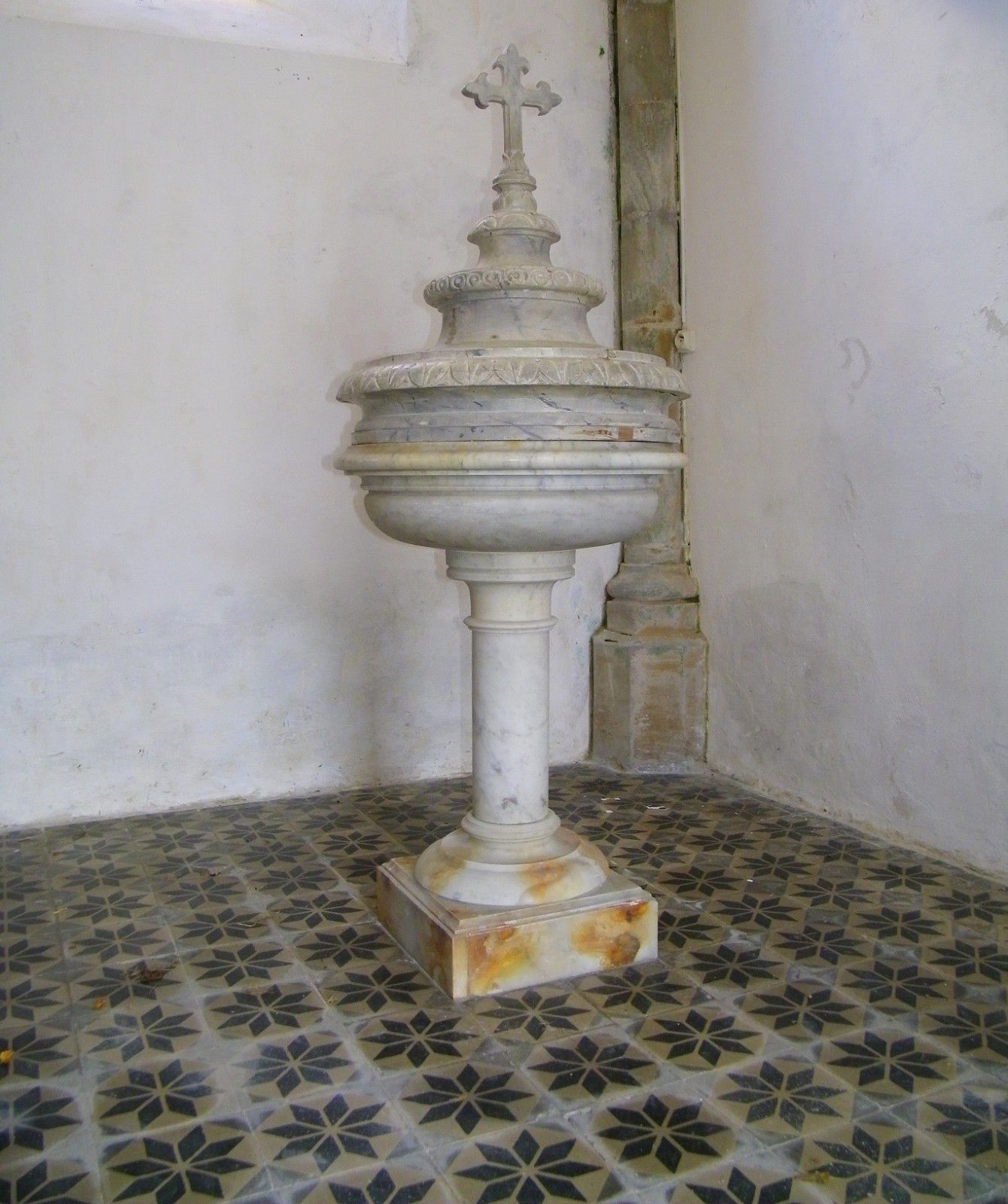 An exquisite marble baptismal font is located near the narthex at the west end of the church.
  The ornate high altar is made of marble and depicts Christ giving Saint Peter the keys to the Church. One final piece of trivia: Stéphane Marie, host of the France 5 television gardening show Silence, ça pousse ! was born here in 1960. He maintains the family garden and it is often the site where each broadcast takes place. The garden is featured in his books and is open to the public once a year.
  Before leaving the village, check out the small chapel by the side of the road. Trust me, there’s no information about it whatsoever on the internet so I’m doing my best to give you accurate information. It is dedicated to the memory of former priest and missionary, Abbé Armand BIHEL who served as the parish priest from 1942 to 1949. He was also known as Père Marie-Floxel BIHEL when he took the habit at the Cistercian Abbey of Notre-Dame-de-Grâce in Bricquebec. In May of 1945 he wrote a special article for a monthly magazine called l’Ami de Tous where he praised the miraculous virtues of the statue of Our Lady of Boulogne.
  “The statue of Our Lady of Boulogne, which throughout the history of France was the object of veneration by the faithful French, arrived centuries ago on the shores of Boulogne, somehow, on a boat without a pilot…. When the Germans arrived in 1940, Notre Dame was not at Boulogne. Step by step she moved throughout the land until she reached the Pyrénées …. Now she returns to her throne and wherever the statue goes, it raises waves of enthusiasm, faith and love. In July, the statue will arrive in the southern part of our Department. On August 23, leaving the main road, it will arrive in Saint-Pierre-d’Arthéglise.”
 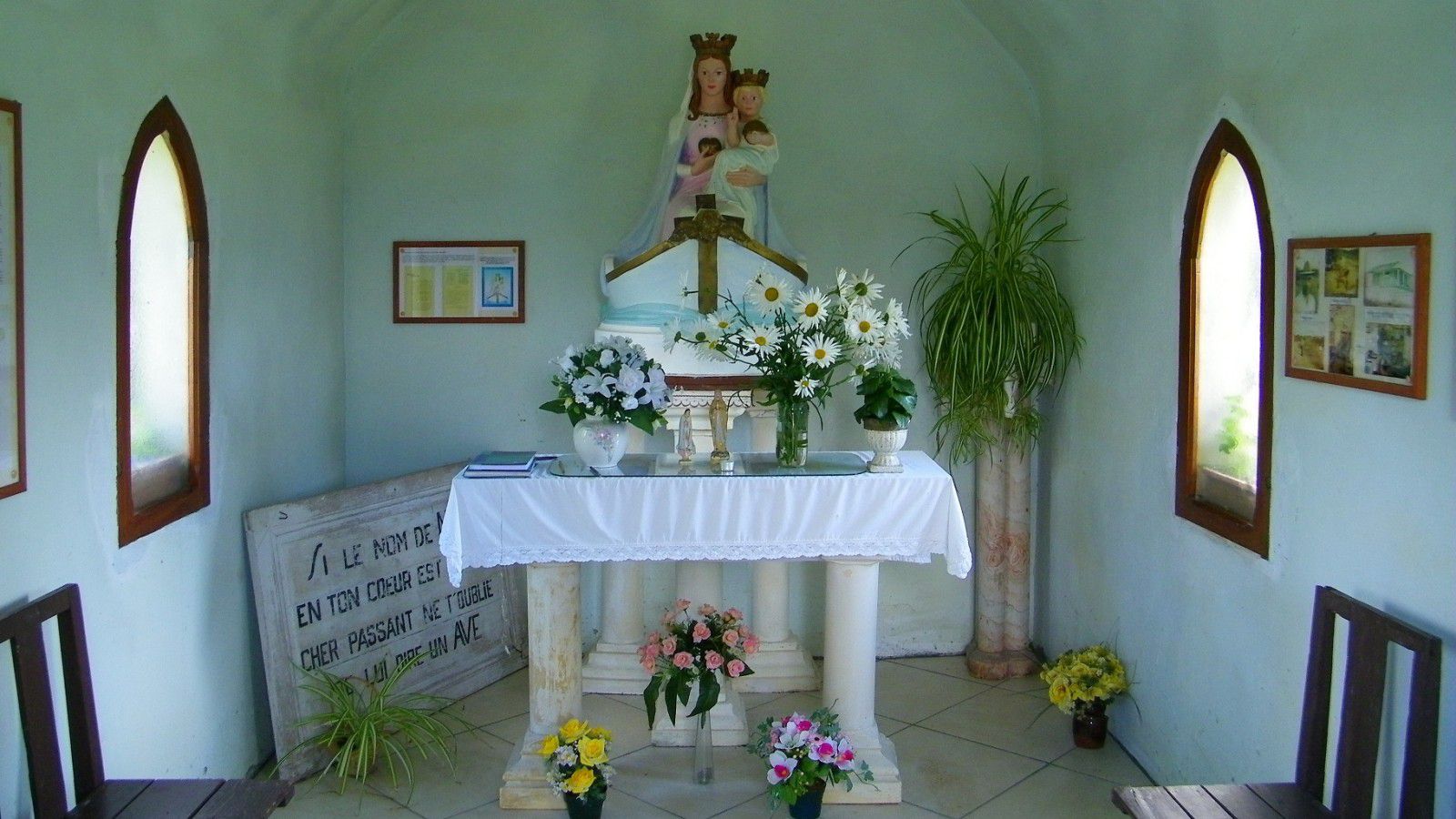 Whether or not this is the actual statue that arrived in the town or a copy, it is interesting to see how it is lovingly well kept.


/http%3A%2F%2Ffarm3.staticflickr.com%2F2931%2F14660046885_d99b0e7a4a_z.jpg)
/http%3A%2F%2Ffarm6.staticflickr.com%2F5496%2F14473453518_46a41559d7_z.jpg)
/http%3A%2F%2Ffarm3.staticflickr.com%2F2904%2F14641208692_9cb9f0aa8a_z.jpg)
/http%3A%2F%2Ffarm6.staticflickr.com%2F5596%2F14454991820_86f0600546_z.jpg)