
De captivants à banals, les articles et photographies de “The Baguette” sont une tentative de publier un journal de ma vie dans la Manche et de proposer un forum de discussion pour tout ce qui touche à la Normandie.
 As many of you know, I was on vacation for the last couple of weeks in the Loire region. I took so many photos that it will take weeks to finish naming and editing them. Still, I will attempt to make a blog posting for my readers to enjoy. The first stop on my trip was the city of Le Mans, born on a rocky spur near the confluence of the Huisne and Sarthe rivers. As early as the prehistoric era, the area was considered sacred.
 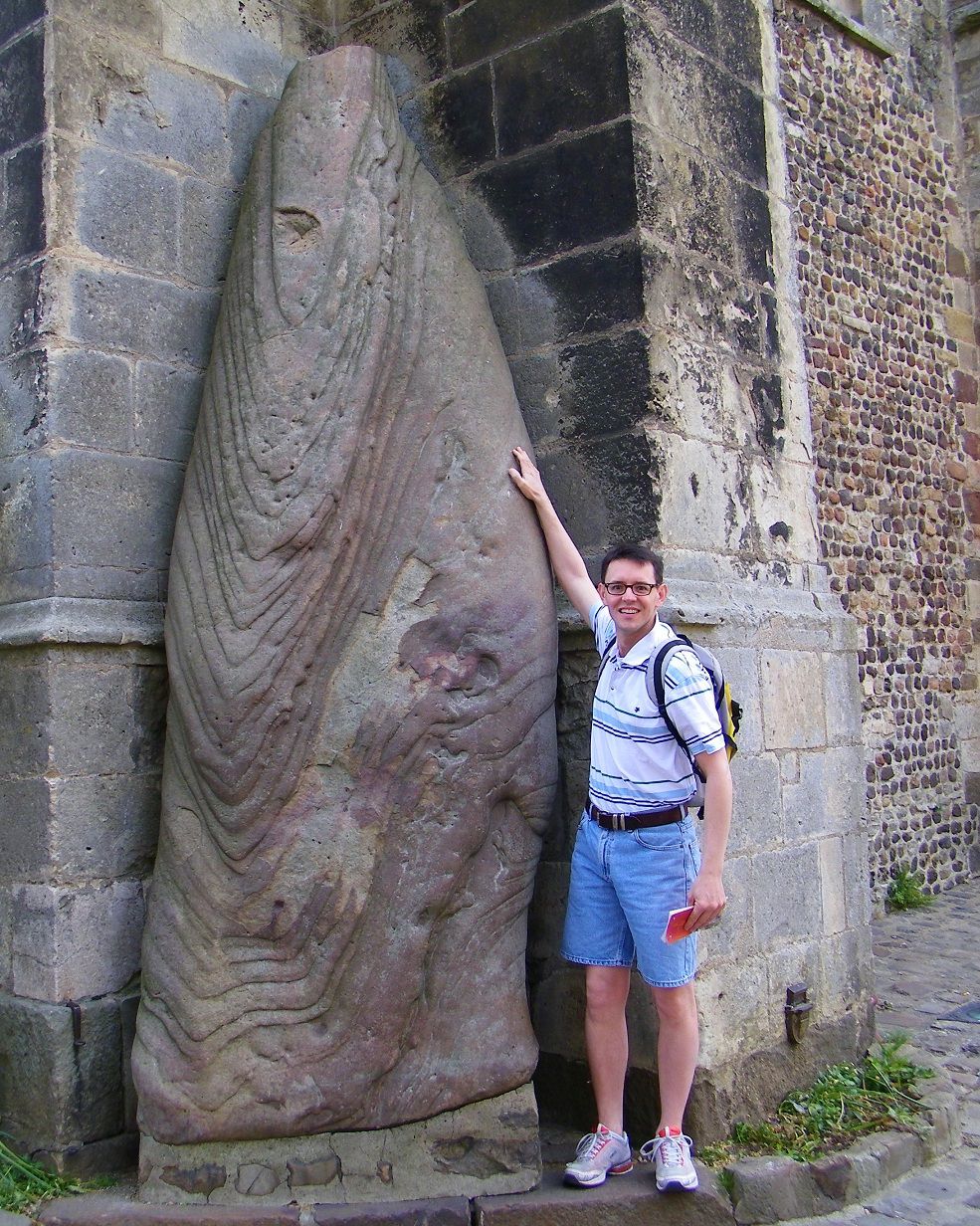 Between 4,000 and 5,000 BC, a prehistoric people raised, within the fortified town, a standing stone or menhir. It is the oldest historical vestige in the city. It was considered for a long time by the inhabitants as the “bellybutton” of Le Mans. Some saw it as the center of the universe, while others believed it to be a symbol of fertility because of its phallic shape. A pagan symbol, it was saved from destruction by Saint-Julien, who came to Le Mans in the 4th century to convert the local population to Christianity. The stone, standing outdoors at the western end of the 11th century Romanesque nave of Cathédrale Saint-Julien, bears testimony to the 7,000 years of the city’s history.
  The church was, first of all, dedicated to the Virgin and to the Milanese Saints Gervais and Protais. In the 9th century, it was dedicated to Saint-Julien, the first evangelist of Le Mans, and whose relics are housed in the sanctuary. The current cathedral was built between the 11th and 15th centuries. These five centuries have given it a diversity of styles that strike a harmony with the combination of the local roussard stone, limestone and glass. It is one of the largest cathedrals in France, measuring 134 meters in length and covering a surface area of 5,000 m².
 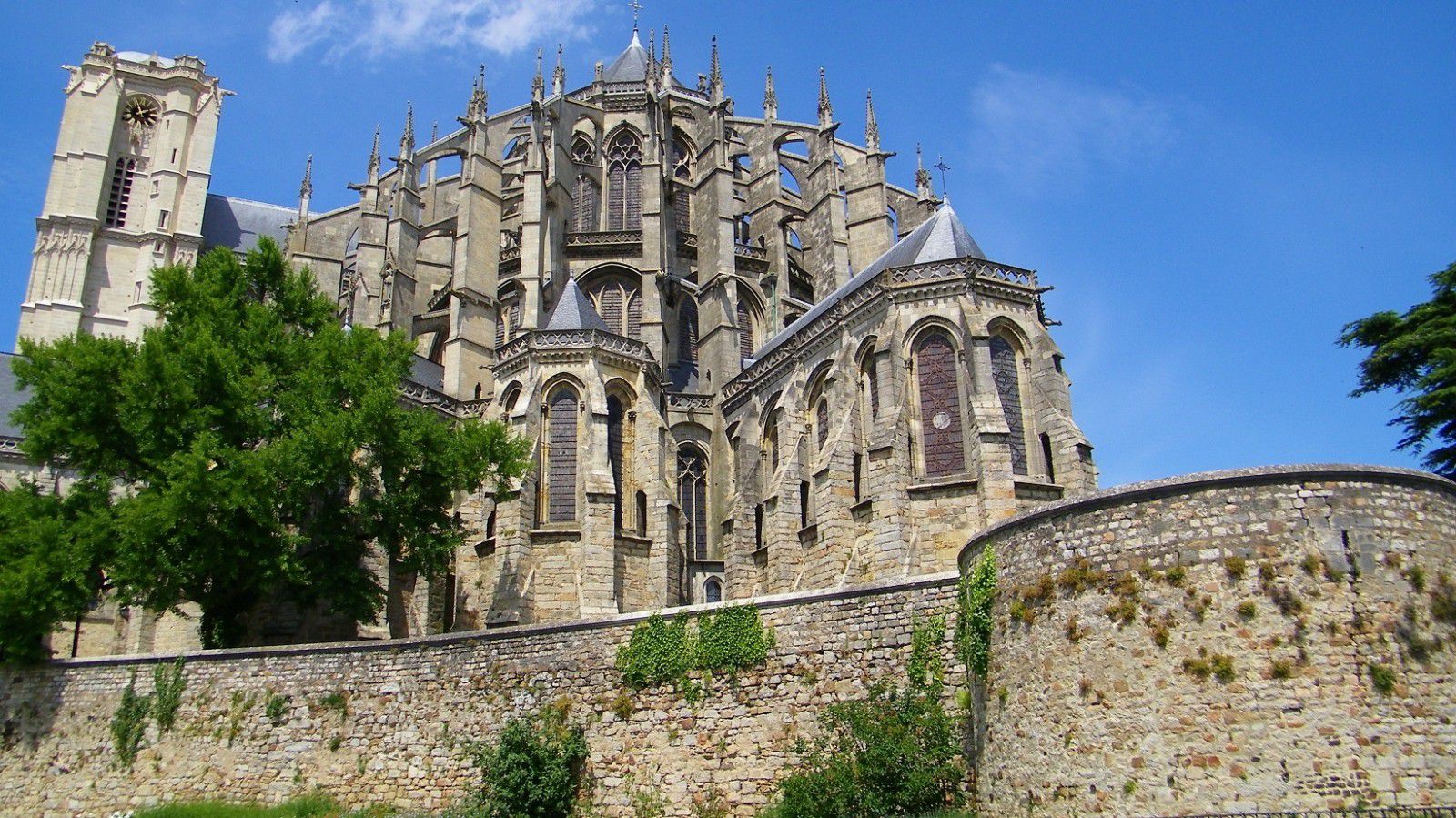 The chevet or eastern end of the cathedral, with its inverted Y-shaped flying buttresses, represents a culminating point in Gothic art. Its thirteen radiating chapels, double ambulatory, and its choir that rises 34meters under the vaults, forms an elegant ascending pyramid.
  The nave, renovated and vaulted by the Plantagenets, is Romanesque. It was used in the 12th century as a place to celebrate major events hosted by the family. In 1128, Geoffrey “the Handsome,” married Matilda, heiress to the English throne. Five years later, the first of their three sons, the future Henry II, was baptized here. The funeral of Richard-the-Lionhearted’s widow, Queen Berengaria, also took place in the cathedral.
  Saint-Julien Cathedral possesses, with Notre-Dame in Chartres, the most beautiful collection of medieval windows. The Ascension window, located in the left side aisle of the nave, is one of the oldest existing stained glass windows (11th century) still in place in a religious building. The one hundred and eight windows (13th century) in the choir filter light into the church and contribute to its reputation as the “Cathedral of Light.”
  The royal entrance, overlooking the charming Place St-Michel has a superb 12th century doorway beneath its portal. The tympanum presents a scene of the Apocalypse.
 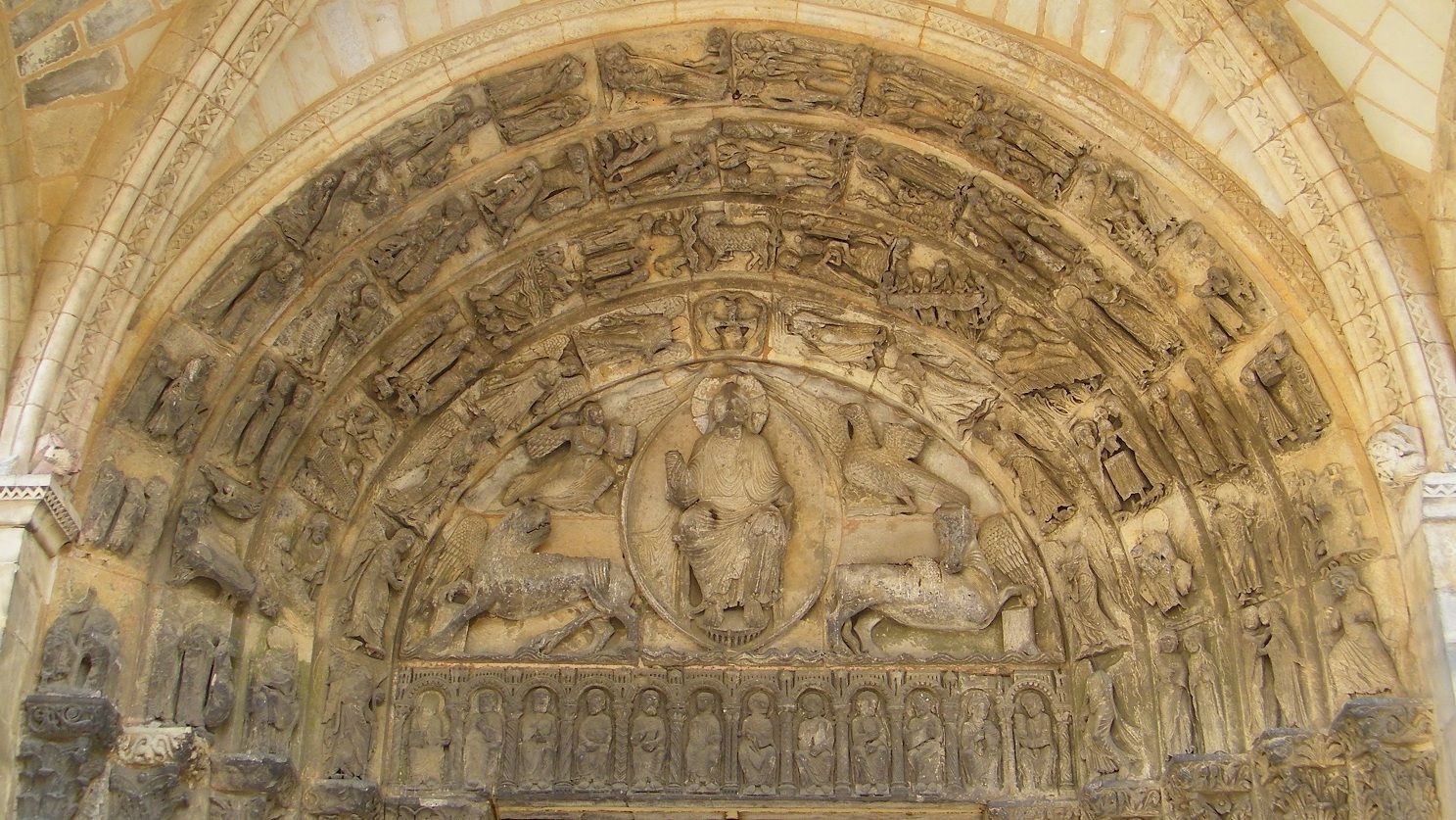 Christ in majesty is there surrounded by an ox, an eagle, a winged lion and an angel, symbols of the four evangelists, Luke, John, Mark and Matthew. The choir, the chapels, the vaults of Saint-Julien were in the medieval era, completely covered with a painted decoration. Painted in the classical era, the walls of the cathedral were stripped in the 19th century.
  Gontier de Baigneux, bishop of Le Mans from 1367 to 1385, had the vaults of the Virgin’s Chapel painted.
  Recently restored, this mural is contemporary with those produced for the Palace of the Popes in Avignon and very close to the Apocalypse hangings in Angers. Forty-seven musician angels radiate with colors, light and harmony.
 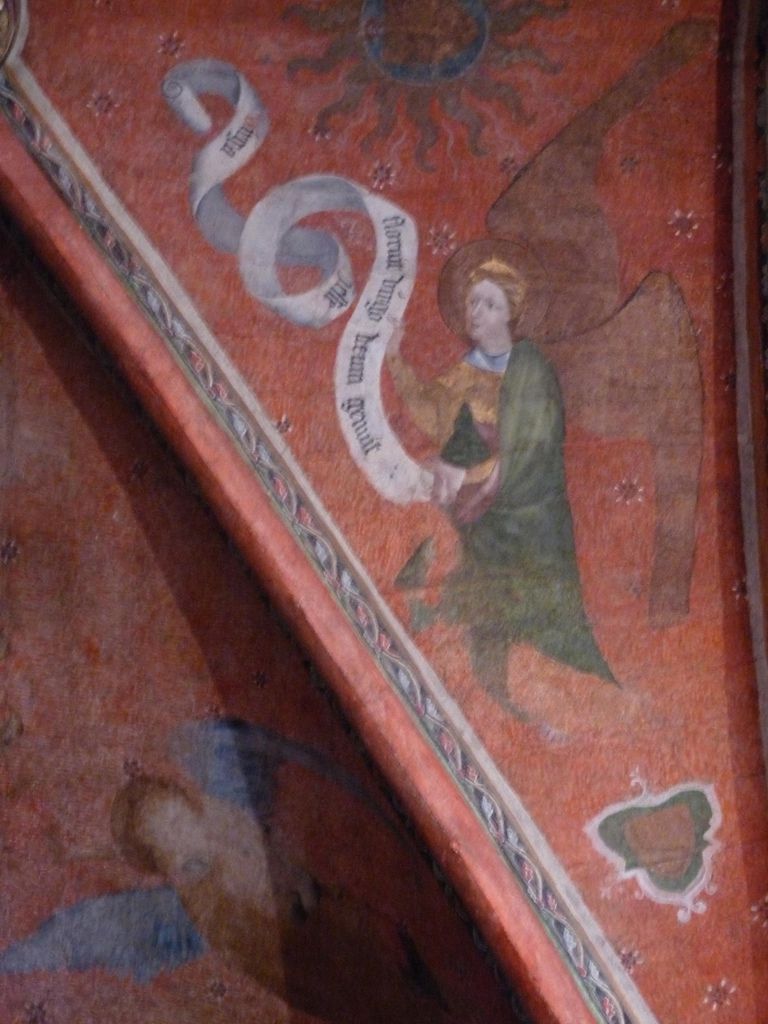 They use 24 different instruments including a mysterious “échiquier” also represented on the great rose window of the transept. The cathedral of Le Mans therefore proves to be a point of reference for specialists in the manufacture of musical instruments in the Middle Ages.
  The 13th century stained glass windows depict the story of Adam and Eve and the Tree of Jesse. The custom of burying bishops and great figures within the cathedral was established in the 9th century. Geoffrey Plantagenet, the princes of Luxembourg and of Bourbon, the du Bellays, were interred here. Only two burial places, today in the Baptismal Fonts Chapel, were spared by the Protestants in 1562.
  Erected in 1472, the tomb of Charles I, count of Maine is the work of the Italian sculptor Francesco Laurana.
  The tomb of Guillaume du Bellay, erected in 1546, is attributed to Pierre Bontemps, made famous by his work on the tomb of Francis I.
  Also located within the Baptismal Fonts Chapel is the Cénotaphe de Saint-Julien. The 17th century saw the birth and patrons of the arts and propagators of Italian art in Maine of earthenware art, whose modelling quality is illustrated by the statuary of the Le Mans cathedral.
  Initially intended for the church of the Cordeliers of Le Mans, the Great Sepulchre, by Gervais Delabarre, expresses the Virgin and the Apostles.
  Signed by Charles Hoyau, the earthenware statue of Sainte-Cécile was recently restored. Commissioned in 1633 to accompany the creation of a great annual contest of musical composition, it displays all the artistic and religious sensitivity of the 17th century.
  At the end of the Middle Ages, no less than around forty altars filled the choir and the transepts. During the 17th century and up until the middle of the 18th century, the adjustments made due to the Catholic Reformation drastically changed the inside of the cathedral. Monseigneur André de Grimaldi had the high altar demolished between 1768 and 1771. He replaced it with a large altar in white marble which has today disappeared.
 The original choir stalls from 1576 were also taken out and made into panels and then moved into the sacristy which features spectacular carvings from the life of Jesus. The side chapels, on each side of the choir, house a series of small enamelled altars, created according to medieval taste fashionable in the 19th century, by a Parisian workshop.


/idata%2F3191025%2FLe-Lude%2F1317-La-facade-Francois-I--Chateau-du-Lude.JPG)
/idata%2F3191025%2FLe-Mans%2F1175-Cloitre--Abbaye-de-l-Epau--1229--Le-Mans.JPG)
/idata%2F3191025%2FLe-Mans%2F1157-Le-Mans-Tramway.JPG)
/idata%2F3191025%2FLe-Mans%2F1160-Maison-de-l-eau--Le-mans.JPG)