
De captivants à banals, les articles et photographies de “The Baguette” sont une tentative de publier un journal de ma vie dans la Manche et de proposer un forum de discussion pour tout ce qui touche à la Normandie.
 On my way south to the Comminges region, I spent some time with good friends who live in a beautiful town just outside of Toulouse called Avignonet-Lauragais. The town is visible from the highway due to the large windmills that generate electricity by harnessing the Autan winds from the southeast. That same highway winds through the ancient “Via Tolosana,” that connects the Atlantic to the Mediterranean.
  What drew my attention was the lovely church of Notre-Dame-des-Miracles built in the 16th century and stands out for many kilometers along the plains of the Haute-Garonne. The main crop of the region is wheat but during the 15th and 16th centuries it was the production of pastels and indigo that brought the region its wealth.
  Perhaps its major claim to fame is the historical massacre of eleven Roman Catholic Inquisitors on May 28, 1242 at the hands of hereticical Cathars and some complicit residents of Avignonet. As the story goes, Catholic inquisitors, Guillaume Arnaud and Étienne de Saint-Thibéry held power in the town. This did not sit well with Pierre-Roger de Mirepoix, a prominent member of the Cathar faith. Therefore, he ordered a small group of his men to go to Avignonet and break the necks of the Inquisitors.
  The troops were greeted during the middle of the night by the complicit castle provost, Raymond Alfaro and the castle bailiff who allowed them to enter. The soldiers surprised the inquisitors while they slept and then hacked them to death with axes, knives and spears. This event was just one of the few which eventually led to the siege at Montségur in March of 1244 where over 220 men, women and children were set on fire for refusing to denounce their Cathar beliefs. Another result of the murders was the defection of many Catholics in the region to the Cathar faith. Residents of Avignonet were punished for 40 years, forbidden to pray in public, forbidden participation in Catholic ceremonies such as baptism and communion and, to make matters worse, their church was closed.
 As for the bodies of the murdered inquisitors, they were transported to Toulouse and buried. By 1643 their tomb was moved to the Cathedral of St-Étienne which can still be seen today. The people felt the punishment and suffered greatly through this long “spiritual winter.” Finally, when the end of their penance was proclaimed, no sooner did they open the doors of their church the tower bells began to ring all day and all night by themselves. This was seen as a miracle and immediately attributed to the Virgin Mary. At that same time, a statue of the Virgin appeared at the steps of the church. Thus began the devotion of Our Lady of Miracles which continues to this day and draws thousands of pilgrims on her feast day, the first Tuesday of June.
  The devotion of Our Lady actually has roots pre-dating the Middle Ages when the population held a strong devotion to Notre-Dame de Gaulège, the first name given to the church in Avignonet. The written source for the devotion to Our Lady of Miracles was formalized in the papal bull of Pope Paul III, dated January 4, 1537, and is still kept within the sacristy of the church. It says that a plenary indulgence will be granted to all faithful who pray in the church of Avignonet on the first Tuesday of June. The inquisitors who were killed in Avignonet were later considered Catholic martyrs and subject to canonization. In the past few centuries, several attempts to elevate them to sainthood have failed. However, on September 6, 1866 the Sacred Congregation of Rites and Blessed Pope Pius IX granted and confirmed the public worship of the eleven victims of the Cathar heresy. Avignonet’s Gothic-style church is rich in artistic and architectural treasures. The construction of the present building began around 1385, lasted over a century and was dedicated February 22, 1512. It is located on the site of a Romanesque church destroyed in 1355 when the Black Prince rode through town. Restored several times, most recently in 1966, the church retains its Gothic character. The exterior architecture deserves ones attention for several reasons.
  The bell tower is undoubtedly the most remarkable, standing 42 meters high and its square base decorated with blind arches. It is surmounted then by two polygonal stories and finally a 10-meter spire.
 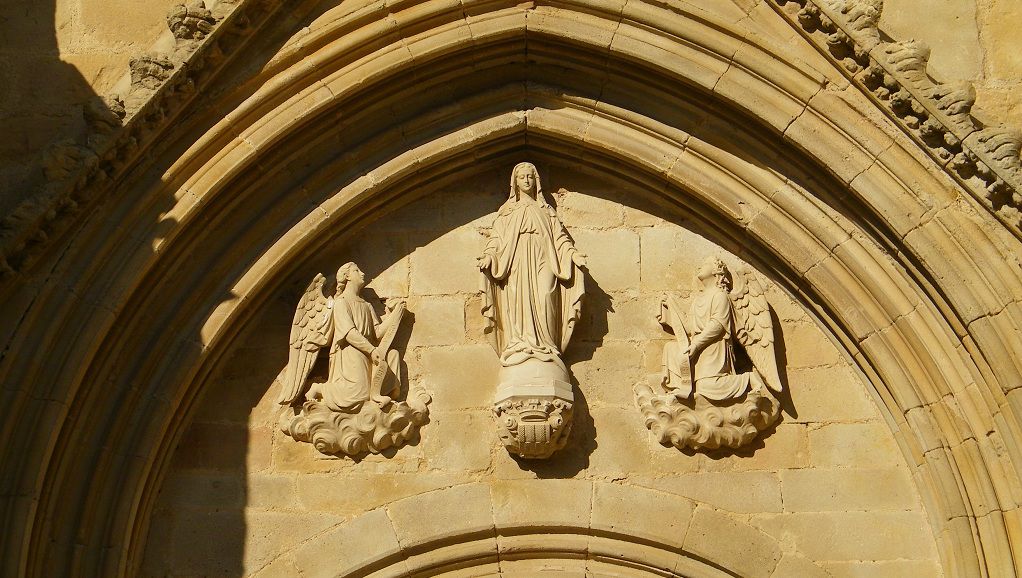 The tympanum of the side entrance has been restored and is decorated with a scene in which the Virgin Mary is the central character. The beautiful capitals adorning the columns to the left and right remained in their original state, although very eroded in places.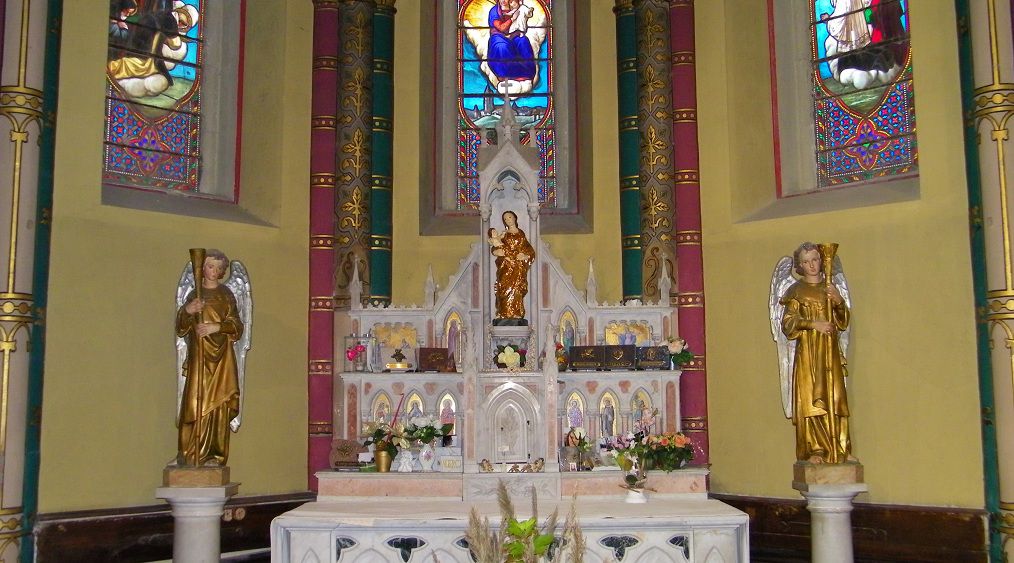
 The chapel dedicated to Our Lady of Miracles is in front of this side door. The present statue of the Virgin is unfortunately not the original which was stolen during the attack of the Huguenots in 1578. Several statues that replaced the original were also stolen in the 17th century, in 1905 and again in 1975.
 Another chapel beside that of Our Lady is just as ornate and covered with angels assisting with the Assumption of the Virgin. The choir is the oldest part of the building.
 The altar and the altarpiece created in the Baroque style have replaced the originals destroyed by the Huguenots in the 16th century. It is of carved wood and gilded in gold leaf with red, marble columns separating sections. As an ensemble, it has been classified as a historical monument since January 17, 1966.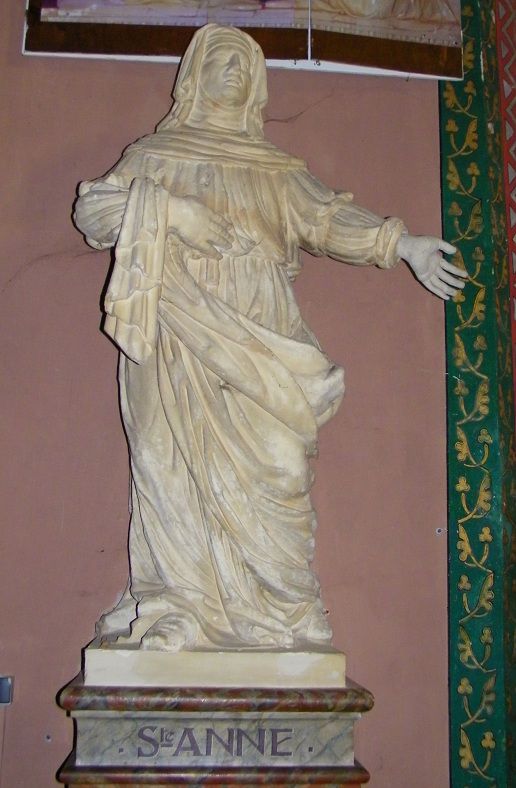
 To the left and right of the altar are statues of the Virgin Mary’s parents, Ste-Anne and St-Joachim. The baptismal font at the back of the church has a stone base which has a wooden cover decorated with the crest and monogram of Christ in Gothic characters. A 21st century restoration has just finished and the results are simply amazing, especially the intricate painting of columns and vaults throughout the church.


 Today, the rich heritage of Avignonet’s past can be traced through its ancient ramparts, its old château with pepper-pot tower, its ancient tower and its beautiful church.
 Throughout the 12th and 17th centuries, limestone ramparts and towers heavily fortified the town.
  The remains of one of these towers, dating from 1610, can be found near the recently rebuilt ramparts at the southern foot of the town. It is conical in shape and originally served as a reinforcement tower beside the Cers gate which protected a drawbridge that led into the city.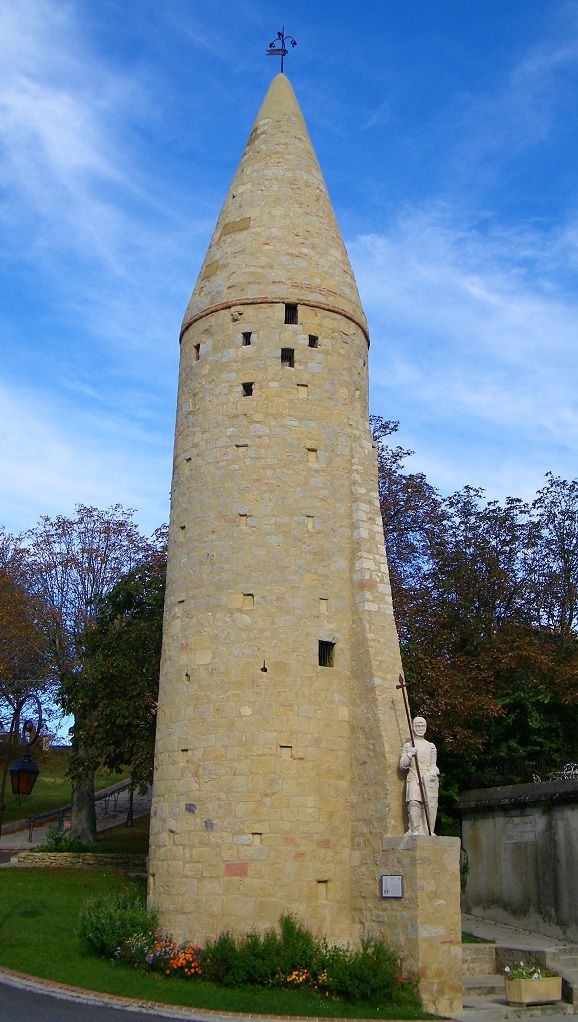

 In 1850 the statue of a crusader was placed on the wall beside the tower and is thought to be that of Simon de Montfort, a prominent leader during the Albigensian Crusade between 1209 and 1229. A water reservoir and public fountain were built here in 1893. During the French Revolution, a famous highway bandit named Michel de Paulo was jailed here where he eventually died.


/http%3A%2F%2Ffarm3.staticflickr.com%2F2922%2F14679955883_19ebe03a53_z.jpg)
/http%3A%2F%2Ffarm6.staticflickr.com%2F5518%2F14455224977_5981185dd7_z.jpg)
/http%3A%2F%2Ffarm8.staticflickr.com%2F7208%2F14035504773_1ed4430ed9_z.jpg)
/http%3A%2F%2Ffarm8.staticflickr.com%2F7300%2F14012320672_1dabb28ee7_z.jpg)